

Patellar Tendonitis
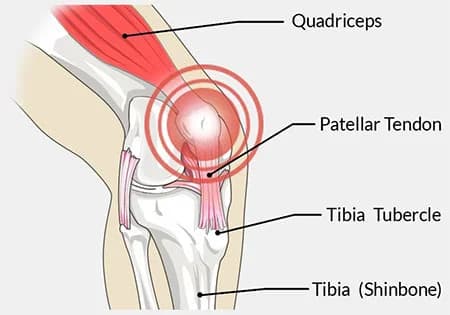
The patellar tendon that connects your kneecap to your shinbone gets a real workout if you're involved in certain sports. Those that require a lot of jumping — such as basketball and volleyball — can set you up for a knee injury like patellar tendonitis. The repetitive movement results in tears in the tendon, which can cause a lot of knee pain. But while basketball players are at high risk, anyone who plays sports can develop a patellar tendon tear.
As with most injuries, pain is the first symptom that lets you know something is amiss. The pain is localized, meaning it's right where the kneecap and tendon are located.
Patellar Tendonitis NYC — SPIN Sports Pain Specialists
Ready to get relief from patellar tendonitis?
Same-day patellar tendonitis appointments available.
Patellar tendon pain doesn't typically radiate to any other locations; it's in the front or just below your kneecap. The pain usually has a typical progression:
- Pain is present at the start of your workout or just after completion of one.
- Pain gradually worsens until you can't exercise or play your sport anymore.
- Finally, the pain interferes with regular, daily motions, such climbing stairs.
Risk Factors
You use your patellar tendon constantly for day-to-day activities. But the addition of competitive sports can really strain your knee joints. Patellar tendonitis is considered an overuse injury, meaning you're doing something that requires the same repetitive movements with little to no breaks in the action.
Additionally, if you choose to suffer and not treat your case of patellar tendon pain, the injury only worsens. The pain increases and may lead to a more serious medical issue. So, don't put off treatment for tendonitis of your knee.
You may be more likely to get patellar tendon tears if:
You're extremely active. If you play sports every day or a variety of sports that all require running or jumping.
Your leg muscles are naturally tight. Quads and hamstrings help reduce the strain on your knees. So, if those large muscles are regularly tight, it puts more strain on your patellar tendon.
Your balance is an issue. Sometimes, because of overuse, the muscles of one leg are much stronger than the other, which can lead to what's called a muscular imbalance. This can cause your muscles to pull irregularly on your patellar tendon, which can lead to injury.
Testing to Confirm Diagnosis
Since there are a variety of things that can be wrong in a complex part of the body like your knee – including a meniscus tear, bursitis, and arthritis, not to mention spraining and breaking a bone – your doctor may recommend a few tests. These include:
Ready to find relief from patellar tendonitis?
Dr. Melepura's Midtown Manhattan clinic offers same-day appointments for evaluation and treatment.
Treatment for Patellar Tendonitis
Once your Manhattan doctor has confirmed that you indeed have one or more patellar tendon tears, treatment for a jumper's knee can commence. As with most injuries, surgery is the last resort.
Instead, your doctor looks to start with over-the-counter pain medications like ibuprofen or acetaminophen. Then it's on to physical therapy, a standard patellar tendonitis treatment. Some things to do to help strengthen the surrounding muscles and increase flexibility include:
- Stretching exercises, easily added to your pre- and post-workout routine
- Strengthening exercises aimed specifically at your quadriceps, which either assist your patella's performance or becomes a strain on your patellar tendon
- Using a patellar tendon strap during workouts to help support your kneecap and relieve pain
- Doing iontophoresis therapy, which uses medicine on the surface of your skin to conduct small electrical charges that pushes the medication into the skin wherever it's needed
Other Patellar Tendonitis Treatment
Another treatment for patellar tendonitis is getting injections of strong medications directly into the joint. Some relieve pain; others help new tissue form to heal your injured tendon. If nothing else works, your New York City sports doctor may suggest a surgical intervention to physically repair your patellar tendon.
You can treat patellar tendon pain at home the way you would any minor injury: by alternating ice and heat applications and elevating your leg while resting. However, if you continue working out without taking care, other symptoms may begin to appear, such as worsening patellar tendon pain, swelling or redness.
Real Stories from our Patients






Dr. Febin Melepura, MD
Double Board-Certified Pain Specialist
Meet Dr. Febin Melepura — Your Patellar Tendonitis Specialist in NYC
Dr. Febin Melepura, MD is a double board-certified interventional pain management specialist and the founder of the Sports Pain Institute of New York. He completed his residency and fellowship training at New York Presbyterian Hospital / Columbia University Medical Center, one of the nation's leading academic medical centers.
He holds dual board certifications from the American Board of Anesthesiology and the American Board of Pain Medicine, and has treated more than 7,500 patients and performed over 5,250 procedures throughout his career. He has been named a Top Pain Management Doctor in New York and one of America's Top Doctors™ by Castle Connolly.
Dr. Melepura's approach to patellar tendonitis is rooted in precision: identify the exact source, treat it with a targeted injection, and get you back to your daily life as quickly as possible.
Ready to Book an Appointment?
Same-day appointments available. Call (212) 621-7746 or book online.
What Our Patellar Tendonitis Patients Say

"Able to make an appointment to see Dr. Melepura on short notice… attentive to my concerns… Jazmin was also very kind and helpful."

"Excellent hospitality, listener and explainer… highly recommend the doctor and the place."
"Dr. Melepura is the best! He worked with me to find the optimal solution to my shoulder pain while I was preparing for a fight!"
"Lovely, bright and modern… doctor and staff were kind… felt my concerns were heard."
"Helpful and friendly staff who gladly follows up with you if and when needed. Dr Melepura was very helpful and professional as well as provided me with excellent information and feedback."
"Dr Febin is fantastic! Highly recommend him and his practice the Spin clinic. The doctor is a good listener, kind, attentive and gave me great advice. "
"Dr.Melepura was very efficient and interpersonal, felt like he was understanding the problems I was having and explained the processes to take to rehabilitate. I would recommend."
"I felt listened to and truly understood by Dr. Melepura. Started PT the very next day. They were very friendly and I didn't feel rushed at all. Already recommended them to my friends who have or continue to play through pain."