

Piriformis Syndrome
One of the causes of sciatica, piriformis syndrome is the medical term for the painful condition that occurs when the piriformis muscle in your buttocks squeezes against your sciatic nerve.
The piriformis muscle plays an important role in the flexibility in your pelvis, but if it gets inflamed, it irritates the sciatic nerve. The result is pain in your back and numbness down one leg.
More frequently, the symptoms of sciatica are caused by a herniated disc in your lower spine.
In fact, the symptoms for sciatica are similar no matter what caused it, so before treatment for piriformis syndrome can be performed, your doctor has to determine that it's the correct diagnosis. See a pain specialist if your symptoms persist.
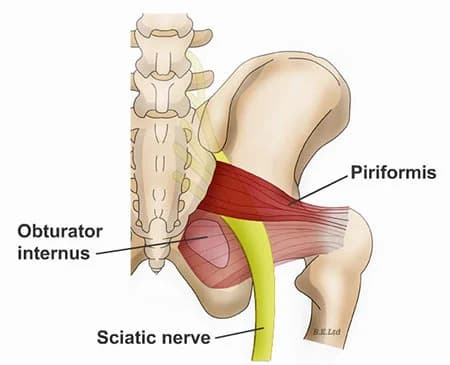
Piriformis Syndrome NYC — SPIN Sports Pain Specialists
Ready to get relief from piriformis syndrome?
Same-day appointments available.
Sciatica Symptoms from Piriformis Syndrome
Sciatica often presents itself as lower back pain that travels from your spine to your buttocks and even down the back of one leg. Because the sciatic is a major nerve serving your lower extremities, you may feel pain anywhere from your back down to your calf. The pain you feel may be a sharp stabbing pain or a dull, constant ache.
Additionally, the pain may be accompanied by tingling or numbness. It's not uncommon for people suffering from sciatica to feel pain in one area of their leg and numbness in another. When you see your New York City doctor, make sure you describe your symptoms as accurately as possible. Your description helps your doctor make an accurate diagnosis, as do the risk factors that apply to you, such as:
- Obesity, which puts extra stress on your spine
- Diabetes, which among other things can lead to nerve damage
- Your age, as you're more susceptible when you're older
- Sitting for extended periods, which puts weight right onto your piriformis muscle
- Certain jobs that force you to sit, carry heavy objects or twist your back
- Improper stretching before working out or playing sports
Diagnosing Piriformis Syndrome
Due to symptoms that reflect sciatica caused by a herniated disc, piriformis syndrome is difficult to diagnose, let alone treat. Usually, diagnosis starts with a complete examination and medical history by your pain specialist. Even then, it may be a matter of eliminating other causes.
To narrow the possibilities, your doctor may stretch your affected leg in various ways, using your pain level as a guide. An x-ray, CT scan, MRI or electromyography may be useful for ruling out other causes. Diagnoses that present a similar symptom — that your doctor has to eliminate — include:
Ready to find relief from piriformis syndrome?
Dr. Melepura's Midtown Manhattan clinic offers same-day appointments for evaluation and treatment.
At-Home Treatment for Piriformis Syndrome
With this condition, your piriformis muscle is inflamed and pressing on your sciatic nerve, so ultimately, the cure is to stop the inflammation, which should stop your symptoms. Before you visit a pain specialist — or as a first recommended piriformis treatment — you can try some at-home or alternative remedies, including:
- Over-the-counter pain medicine, such as non-steroidal, anti-inflammatory drugs (NSAIDs)
- Cold temperature treatments applied directly to the base of your spine, right above your buttocks, for up to 20 minutes to help reduce swelling
- Warm temperature treatments
- Alternating warm and cold
- Lower back stretches aimed at the piriformis muscle
- Time off from work, if your job aggravates your symptoms
- Chiropractic adjustment is sometimes effective for increasing mobility in your hips
Piriformis Syndrome Treatments
If your pain and symptoms don't go away within a week of at-home treatments, make an appointment with your sports medicine and pain physician in New York City. Treatment for piriformis syndrome begins with targeted physical therapy. Prescription-strength muscle relaxants or other types of medications, such as anti-depressants, are the next step.
If these remedies don't work, you may need stronger piriformis syndrome treatment.
A trigger point injection can calm your piriformis muscle, alleviating your symptoms.
A lumbosacral epidural steroid injection may be the better choice for you. Only your doctor can decide.
Treatment for piriformis syndrome is usually effective, but you must do your part afterward to keep the condition from recurring. Start a regular exercise regimen, watch your posture at all times — especially while sitting — and don't lift objects using improper form. Do these things and you'll never need piriformis syndrome treatment again.
Real Stories from our Patients






Dr. Febin Melepura, MD
Double Board-Certified Pain Specialist
Meet Dr. Febin Melepura — Your Piriformis Syndrome Specialist in NYC
Dr. Febin Melepura, MD is a double board-certified interventional pain management specialist and the founder of the Sports Pain Institute of New York. He completed his residency and fellowship training at New York Presbyterian Hospital / Columbia University Medical Center, one of the nation's leading academic medical centers.
He holds dual board certifications from the American Board of Anesthesiology and the American Board of Pain Medicine, and has treated more than 7,500 patients and performed over 5,250 procedures throughout his career. He has been named a Top Pain Management Doctor in New York and one of America's Top Doctors™ by Castle Connolly.
Dr. Melepura's approach to piriformis syndrome is rooted in precision: identify the exact source, treat it with a targeted injection, and get you back to your daily life as quickly as possible.
Ready to Book an Appointment?
Same-day appointments available. Call (212) 621-7746 or book online.
What Our Piriformis Syndrome Patients Say

"Able to make an appointment to see Dr. Melepura on short notice… attentive to my concerns… Jazmin was also very kind and helpful."

"Excellent hospitality, listener and explainer… highly recommend the doctor and the place."
"Dr. Melepura is the best! He worked with me to find the optimal solution to my shoulder pain while I was preparing for a fight!"
"Lovely, bright and modern… doctor and staff were kind… felt my concerns were heard."
"Helpful and friendly staff who gladly follows up with you if and when needed. Dr Melepura was very helpful and professional as well as provided me with excellent information and feedback."
"Dr Febin is fantastic! Highly recommend him and his practice the Spin clinic. The doctor is a good listener, kind, attentive and gave me great advice. "
"Dr.Melepura was very efficient and interpersonal, felt like he was understanding the problems I was having and explained the processes to take to rehabilitate. I would recommend."
"I felt listened to and truly understood by Dr. Melepura. Started PT the very next day. They were very friendly and I didn't feel rushed at all. Already recommended them to my friends who have or continue to play through pain."