

Sacroiliac Joint Dysfunction
You actually have two SI joints. They sit in your lower back on both sides of your spine. Their main job is to shift and support the weight of your upper body to your legs when you stand and walk. If you're living with sacroiliac joint dysfunction, the act of standing often triggers pain. The pain from your SI joint dysfunction may be dull or sharp. And even though it starts at your SI joint, it can spread to your:
- Upper back
- Buttocks
- Groin
- Thighs
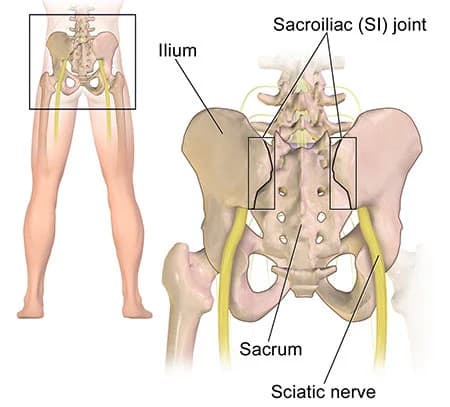
Sacroiliac Joint Dysfunction NYC — SPIN Sports Pain Specialists
Ready to get relief from sacroiliac joint dysfunction?
Same-day SI joint appointments available.
Are You a Candidate for Sacroiliac Joint Dysfunction Treatment?
Swelling in your SI joint triggers your pain. Injury can result in SI joint problems, and so sacroiliac joint dysfunction is especially common in athletes. Years of wear and tear take a toll on your body — particularly the repetitive jarring of jogging and running.
These problems are further exaggerated if your stride is uneven. An uneven stride can be the result of injury, although, in some people, one leg is just naturally longer than the other. The difference may be so slight that you go your entire life without ever noticing it — until you start feeling back pain.
It's also possible for you to damage the ligaments that hold your SI joints together. When your weakened ligaments allow your SI joint to move abnormally, it can lead to damage to the SI joint itself. This is quite uncomfortable and gets progressively worse.
Pregnancy is also a common trigger of SI joint trouble. The hormones your body releases during pregnancy cause your joints and ligaments to loosen up for the changes your body has in store. This often changes the way that your joints move, and SI joint dysfunction may follow.
Arthritis sometimes is the end result of SI joint troubles. But problems with your SI joint may be caused by a specific type of arthritis that affects your spine called ankylosing spondylitis. The symptoms of ankylosing spondylitis include stiffness and pain from your neck down. This condition leads to a stooped-over posture.
Treatment for Sacroiliac Joint Dysfunction
First things first: you're going to have to refrain from whatever activity is aggravating your condition. This may mean quitting the company softball team or opting for water aerobics instead of your usual morning jog. You'll have to cut back on any activity that stresses or inflames your SI joint.
Through your sport and pain medicine doctor, you have a couple of sacroiliac joint dysfunction treatment options available to you:
- Physical therapy and rehabilitation are generally great ideas for anyone experiencing SI joint pain. Exercising improves strength, flexibility, and function. You'll be surprised to discover the many bad habits you develop when you're living with pain. You may:
- Walk with a limp
- Take uneven strides
- Lean to one side
Your physician may recommend:
- Hot and cold treatments
- Ultrasound
- Stretching
- Massage therapy
Ready to find relief from sacroiliac joint dysfunction?
Dr. Melepura's Midtown Manhattan clinic offers same-day appointments for evaluation and treatment.
Sacroiliac Joint Dysfunction Treatment
Cortisone injections
can significantly reduce the inflammation in your SI Joint. Then your pain disappears as well.
Nerve treatments
can be used to block the signals of pain between your brain and your SI joint.
Radiofrequency ablation
, while it's not as widely used, can safely stop a nerve from sending those pain messages, too.
Chiropractic adjustments
that move muscles and joints can in some cases relieve your pain.
Surgery
is required in more extreme cases if less invasive treatments aren't bringing you relief. The procedure is called SI joint fusion. A surgeon uses a series of pins and implants to secure the bones near your joint.
Treatment for sacroiliac joint dysfunction usually goes a long way toward reducing any inflammation you may be experiencing. But in the off-chance that you're still living with discomfort after receiving treatment, contact your doctor immediately. SI joint problems can get much worse over time.
SI joint problems do more than cause pain, too; they can also destroy your joint completely if left untreated. By reducing the stress and strain on your SI joint, you reduce your chances for permanent damage and arthritis. While you can't beat the natural aging process, with the help of an experienced team of pain management specialists, you can have an impact on the severity of your condition.
Real Stories from our Patients










Dr. Febin Melepura, MD
Double Board-Certified Pain Specialist
Meet Dr. Febin Melepura — Your Sacroiliac Joint Dysfunction Specialist in NYC
Dr. Febin Melepura, MD is a double board-certified interventional pain management specialist and the founder of the Sports Pain Institute of New York. He completed his residency and fellowship training at New York Presbyterian Hospital / Columbia University Medical Center, one of the nation's leading academic medical centers.
He holds dual board certifications from the American Board of Anesthesiology and the American Board of Pain Medicine, and has treated more than 7,500 patients and performed over 5,250 procedures throughout his career. He has been named a Top Pain Management Doctor in New York and one of America's Top Doctors™ by Castle Connolly.
Dr. Melepura's approach to sacroiliac joint dysfunction is rooted in precision: identify the exact source, treat it with a targeted injection, and get you back to your daily life as quickly as possible.
Ready to Book an Appointment?
Same-day appointments available. Call (212) 621-7746 or book online.
What Our Sacroiliac Joint Dysfunction Patients Say

"Able to make an appointment to see Dr. Melepura on short notice… attentive to my concerns… Jazmin was also very kind and helpful."

"Excellent hospitality, listener and explainer… highly recommend the doctor and the place."
"Dr. Melepura is the best! He worked with me to find the optimal solution to my shoulder pain while I was preparing for a fight!"
"Lovely, bright and modern… doctor and staff were kind… felt my concerns were heard."
"Helpful and friendly staff who gladly follows up with you if and when needed. Dr Melepura was very helpful and professional as well as provided me with excellent information and feedback."
"Dr Febin is fantastic! Highly recommend him and his practice the Spin clinic. The doctor is a good listener, kind, attentive and gave me great advice. "
"Dr.Melepura was very efficient and interpersonal, felt like he was understanding the problems I was having and explained the processes to take to rehabilitate. I would recommend."
"I felt listened to and truly understood by Dr. Melepura. Started PT the very next day. They were very friendly and I didn't feel rushed at all. Already recommended them to my friends who have or continue to play through pain."