Sciatica
Sciatica is not just back pain - it is nerve pain. When the sciatic nerve becomes compressed or irritated, it produces a very specific pattern: sharp, burning, or shooting pain that radiates from the lower back through the buttock and down the leg, sometimes reaching the foot. The pain often worsens with sitting, standing for long periods, or certain movements.
Left untreated, sciatica can progressively worsen and interfere with everything from walking to sleeping. Finding the right diagnosis and treatment plan early makes a meaningful difference in outcomes.
At Sports Pain Management NYC (SPIN), our board-certified sciatica doctors identify the root cause of your nerve pain - whether it is a herniated disc, bone spur, spinal stenosis, piriformis syndrome, or another source - and build a targeted, non-surgical treatment plan around it. If you are searching for a sciatica doctor in NYC, looking for doctors that treat sciatica near you, or have already tried home remedies without success, SPIN offers same-week appointments with specialists who treat this condition every day.
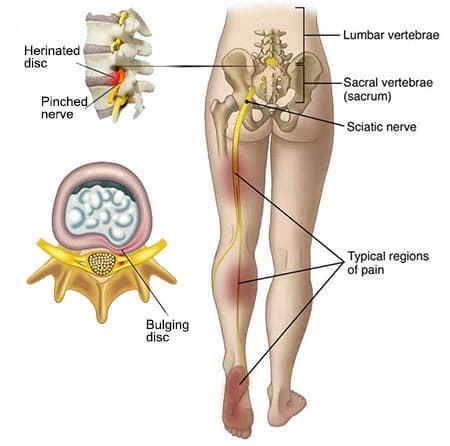
Sciatica — Sciatic Nerve Compression & Irritation
Ready to get rid of your sciatica?
If you're searching for a sciatica specialist in NYC, same-day appointments are available.
Symptoms of Sciatica
Your sciatic nerve lets you know when it's unhappy. The doctors at the Sports and Pain Institute of NY report the most common symptom is pain radiating from your lower back down to the back of your thigh. Typically, it affects only one side of your body.
Sciatic nerve pain varies in intensity from mild to excruciating. Your pain can feel like a burning sensation, a sharp stabbing pain, or even an electric shock. The pain may be accompanied by muscle weakness.
Diagnosis for Sciatica Pain
Our pain specialist Dr. Melepura starts with a physical exam. For sciatica pain relief, your doctor needs first to identify the cause, which may include:
- Slipped disc
- Spinal stenosis
- Piriformis syndrome
- Pelvic injury or fracture
- Tumors
- Sports Injury
A proper diagnosis is required to get the best sciatica treatment. Range of motion tests may reveal what's triggering your pain. Additional diagnostic exams may be necessary if the pain is exceptionally strong or doesn't improve with rest. Dr. Melepura and specialists at the Sports and Pain Institute know how to treat sciatica once they have a diagnosis.
Sciatica Pain Relief
You may find that staying active helps relieve sciatica pain. If your pain becomes too great, lie down for short periods. When your pain diminishes, take short walks at a gentle pace. Sitting increases the pressure on your sciatic nerve, making the pain worse. Your best option is to limit sitting and driving.
The good news is that relief occurs naturally over three to four weeks for 75 percent of the people who suffer from it. The challenge is how to manage your pain until you heal. The Sports and Pain Institute of NY specialists are experts in managing your pain. They know how to treat sciatica, so you get the pain relief you need.
Medical Treatment for Sciatica
Medical sciatica treatments are wide-ranging, from pharmaceuticals to surgery. How to treat sciatica depends on the severity of the nerve damage, how your body heals and how you respond to treatment. Consult with your specialist about what's best for you.
Medications can give you lumbar radiculopathy pain relief. Steroid injections relieve sciatica pain by reducing the inflammation and pressure on the sciatic nerve. But these injections wear off over time, and you need medical oversight to ensure they're working properly.
Commonly prescribed medications by Dr. Melepura to quickly relieve the pain in the lower back radiating to the leg include:
- Anti-inflammatories
- Anti-seizure medications
- Muscle relaxants
Surgery for sciatica relief is necessary only in extreme cases. If severe symptoms persist, you may be advised to consider it. Symptoms that indicate the possible need for surgery include:
- Loss of bladder or bowel control
- Pain progressively worsening
- Significant muscle weakness
Home Treatment for Sciatica
Your doctor may recommend that you use appropriate self-care. The most common at-home treatment for sciatica that your doctor may explain includes:
- Cold packs to reduce inflammation
- Hot packs to help muscles relax
- Stretching to relieve painful nerve compression
- Over-the-counter medication, such as non-steroidal anti-inflammatory drugs (NSAIDs) like aspirin or acetaminophen for pain relief and reducing swelling
Sciatica treatment gets you out of pain and back to moving freely. Choosing the right medical practice, whose doctors are experts in lumbar radiculopathy treatments, is a giant first step to sciatica pain relief. Doctors at the Sports and Pain Institute of NY know how to treat sciatica nerve pain and get you out of pain as quickly as possible. They know which sciatica treatment will work best for you.
When to See a Sciatica Specialist
Most mild sciatica episodes improve within 4-6 weeks with rest and conservative care. But there are clear warning signs that mean you should see a sciatica specialist sooner rather than later:
- Pain has persisted for more than 4-6 weeks without meaningful improvement
- The pain is severe, shooting, or burning - not just dull or achy
- You are experiencing numbness, tingling, or weakness in your leg or foot
- You have lost bladder or bowel control (seek emergency care immediately)
- Your pain is disrupting sleep or waking you at night
- You have tried over-the-counter treatments with no relief
- Symptoms are progressively worsening rather than improving
Seeing a specialist early matters because untreated sciatic nerve compression can cause progressive nerve damage. The earlier the root cause is identified, the better your outcomes from conservative treatment - and the lower the risk that more aggressive intervention becomes necessary.
Sciatica Doctor in NYC - Expert Pain Management at SPIN
Choosing the right sciatica doctor in NYC is the most important step toward recovery. Sciatica is frequently misdiagnosed or undertreated when its root cause is not correctly identified. Conditions including piriformis syndrome, hip bursitis, sacroiliac joint dysfunction, and peripheral neuropathy can all mimic true sciatica - and each requires a different treatment approach.
At SPIN, our physicians are board-certified in pain medicine with fellowship training in interventional spine procedures. Sciatica is a primary specialty, not a secondary concern. Our sciatica specialists in NYC have treated thousands of patients - from acute disc herniations in young athletes to chronic degenerative sciatica in older adults - using targeted injection techniques that most primary care offices cannot offer.
What Our Sciatica Doctors Do Differently
Accurate diagnosis first. We start with a detailed clinical evaluation and review any existing imaging (MRI, X-ray). Where imaging has not been obtained and is clinically indicated, we order it before proceeding. Treatment is only as good as the diagnosis underneath it.
Injection precision. Our lumbar epidural steroid injections, selective nerve root blocks, and sacroiliac joint injections are performed under fluoroscopic or ultrasound guidance. This means the medication reaches the exact site of nerve irritation - not an approximated landmark.
Non-surgical commitment. We exhaust all conservative and minimally invasive options before making any surgical referral. For most patients with sciatica, surgery is never required.
Coordination with physical therapy. Injection therapy works best as part of a broader plan. We coordinate with physical therapists to ensure the window of pain relief from an injection is used productively to build strength and restore spinal mechanics.
Who We Treat
We see patients across all stages of sciatica severity:
- Acute disc herniation with radiating leg pain - first-time episodes in otherwise healthy patients
- Chronic sciatica - recurring or persistent symptoms lasting months or years
- Post-surgical sciatica - persistent nerve pain following a previous spine procedure
- Sciatica from spinal stenosis - nerve root compression due to narrowing of the spinal canal
- Piriformis syndrome - sciatic nerve irritation caused by the piriformis muscle rather than a disc
Booking a Sciatica Appointment in NYC
SPIN is located in Midtown Manhattan and is convenient for patients from all five boroughs and New Jersey. We offer same-week and next-day appointments for new patients, accept most major insurance plans, and provide Spanish-language services on request. Call our office or book online to schedule your evaluation.
Ready to Book an Appointment?
Same-day appointments available. Call (212) 621-7746 or book online.
Sciatica Treatment Options in NYC
Sciatica treatment is not one-size-fits-all. The right intervention depends on the location of nerve compression, the severity of symptoms, how long you have been experiencing sciatica, and whether any prior treatments have been tried. At SPIN, our sciatica treatment plans are built around your specific MRI findings and clinical presentation.
Lumbar Epidural Steroid Injections
The gold standard for disc-related sciatica. A lumbar epidural steroid injection (ESI) delivers concentrated anti-inflammatory medication directly into the epidural space - the area surrounding the compressed nerve root - at the precise spinal level responsible for your symptoms. This reduces inflammation around the nerve, relieving pain and allowing you to engage in physical therapy and resume normal activity. Most patients experience meaningful improvement within 3-7 days of the injection. ESIs are performed under fluoroscopic (live X-ray) guidance to ensure accurate needle placement.
Selective Nerve Root Blocks
When the source of sciatica is a specific nerve root rather than a broad epidural area, a selective nerve root block provides more targeted treatment. The injection is placed at the exact level and side of the compressed nerve, delivering medication with maximum precision and minimal spread to unaffected tissue.
Sacroiliac Joint Injections
When SI joint dysfunction is contributing to or causing your symptoms - a common misdiagnosis that looks clinically similar to true sciatica - a sacroiliac joint injection both confirms the diagnosis and provides therapeutic relief.
Piriformis Injections
For patients whose sciatica originates from piriformis muscle irritation rather than a disc or spine issue, a piriformis injection delivers anti-inflammatory medication or botulinum toxin directly to the muscle, relieving pressure on the sciatic nerve.
Physical Therapy and Rehabilitation
Injection therapy works best when combined with structured physical therapy. The pain relief window created by an injection allows patients to engage in core strengthening, hip mobility work, and postural correction - all of which reduce the likelihood of recurrence.
Oral Medications
As part of a comprehensive plan, oral anti-inflammatories (NSAIDs), nerve pain medications (gabapentin, pregabalin), and muscle relaxants can play a supporting role in managing symptoms while more targeted treatments take effect.
When Is Surgery Necessary for Sciatica?
Most sciatica patients do not need surgery. Surgery is reserved for cases involving progressive neurological deficits, such as worsening leg weakness or bladder and bowel dysfunction, or cases with structural instability that cannot be managed with interventional care. If surgery is indicated, Dr. Melepura will provide a clear explanation and a referral to a trusted spine surgeon.
Real Stories from our Patients




Dr. Febin Melepura, MD
Double Board-Certified Pain Specialist
Meet Dr. Febin Melepura — Your Sciatica Specialist in NYC
Dr. Febin Melepura, MD is a double board-certified interventional pain management specialist and the founder of the Sports Pain Institute of New York. He completed his residency and fellowship training at New York Presbyterian Hospital / Columbia University Medical Center, where he specialized in interventional pain management.
He holds dual board certifications from the American Board of Anesthesiology and the American Board of Pain Medicine, and has treated more than 7,500 patients and performed over 5,250 procedures throughout his career. He has been named a Top Pain Management Doctor in New York and one of America's Top Doctors™ by Castle Connolly.
Dr. Melepura's approach to sciatica is rooted in accurate diagnosis first — identifying the exact cause of nerve compression — and then treating it with precision, using non-surgical interventions wherever possible.
Ready to Book an Appointment?
Same-day appointments available. Call (212) 621-7746 or book online.
What Our Sciatica Patients Say

"Able to make an appointment to see Dr. Melepura on short notice… attentive to my concerns… Jazmin was also very kind and helpful."

"Excellent hospitality, listener and explainer… highly recommend the doctor and the place."
"Dr. Melepura is the best! He worked with me to find the optimal solution to my shoulder pain while I was preparing for a fight!"
"Lovely, bright and modern… doctor and staff were kind… felt my concerns were heard."
"Helpful and friendly staff who gladly follows up with you if and when needed. Dr Melepura was very helpful and professional as well as provided me with excellent information and feedback."
"Dr Febin is fantastic! Highly recommend him and his practice the Spin clinic. The doctor is a good listener, kind, attentive and gave me great advice. "
"Dr.Melepura was very efficient and interpersonal, felt like he was understanding the problems I was having and explained the processes to take to rehabilitate. I would recommend."
"I felt listened to and truly understood by Dr. Melepura. Started PT the very next day. They were very friendly and I didn't feel rushed at all. Already recommended them to my friends who have or continue to play through pain."
Frequently Asked Questions About Sciatica
A pain management specialist, physiatrist, or orthopedic spine specialist. At SPIN, our board-certified pain management physicians both diagnose sciatica and perform the injection procedures that provide the fastest relief.